
JESUS AND MONEY
‘Jesus the Troublemaker’ is a novel I wrote about the last eight days of Jesus’ life. He spent at least four days teaching in the Temple doing that period, so I included an earlier typical incident from Luke. A young man says his brother is taking all the wealth his father left when he died and he asks Jesus to intervene – not unreasonable. But Jesus will have none of it. “Man, who made me a judge or arbitrator? Don’t be greedy.” Why was Jesus so dismissive?
The most terrifying verse I reckon is Mark 10.21. A young man comes up to Jesus to ask about eternal life. When he says that he has kept the commandments since childhood, we are told that “Jesus looking at him, loved him and said, “You lack one thing. Go, sell what you own, give that money to the poor and you will have treasure in heaven, then come, follow me.”
That’s a pretty surprising thing to say out of love. But it is of a piece with Jesus’ overall attitude. Jesus summed it up in the beatitudes in Luke 6.20f:
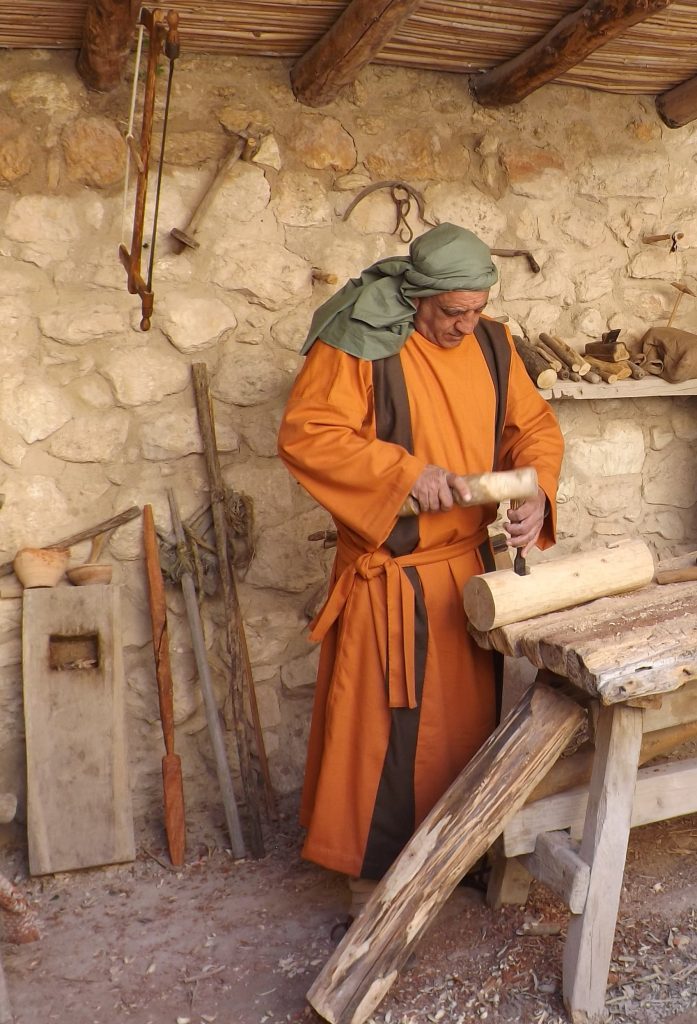
Carpenter in Nazareth Village
“Blessed are you poor, for yours is the kingdom of heaven…

“Woe to you who are rich, for you have received your consolation.”
Some Christians insist that we should take the Bible literally. But they don’t. How many obey Jesus when he says, “None of you can become my disciple if you do not give up all your possessions.” (Luke 14.33)
But some do. Monks and nuns give up all their possessions out of devotion to Jesus and a desire to live a life of prayer. In the middle ages, conversion meant just that.
Herod’s palace a Masada (model)

And yet …
Jesus was more than happy to accept hospitality from tax collectors and sinners, getting a reputation for being a ‘glutton and a drunkard’ (Luke 7.34). He was supported by a group of well-off women:
The twelve were with him,as well as some women who had been cured of evil spirits and infirmities: Mary, called Magdalene, from whom seven demons had gone out,and Joanna, the wife of Herod’s steward Chuza, and Susanna, and many others, who provided for them out of their resources. (Luke 8.1-3)
Jesus’ friends in Bethany, Eleazar (or Lazarus), Martha and Mary clearly had a large house, could afford an expensive funeral and provided a good festive meal. (John 11, 12)
The story of Zacchaeus
Nowhere is Jesus’ surprising attitude to money shown as in the story of the chief tax collector Zacchaeus. Here is how I told it in ‘Jesus the Troublemaker’. Note that everyone is given their actual Aramaic name, with Jesus being called Yeshua.

‘As they made their way between the square whitewashed houses and their security walls, Yeshua stopped and looked curiously at a tree two hundred paces away.
He leant towards an elderly man near him and asked, “Who’s the man up that tree?”
The man looked up and his mouth dropped open in surprise. With a grimace he said, “I can’t believe it. That’s – that’s Zakkai! And up a tree, in the name of Elaha!”
“And just who is Zakkai?”
“Only the head of the tax farmers in the region. And, by Elaha, doesn’t he farm the taxes well. He’s a swindler, an extortioner, a miser and a Roman toady. He’s got half our town in debt to pay for his rake-off. His name Zakkai – Righteous – what a joke! And now,

unbelievably, he’s climbing a tree! Doesn’t he have any dignity?”
“I can see why he’s unpopular,” said Yeshua thoughtfully. “But still,” he smiled disconcertingly, “he does climb trees.”
They reached the spot where Zakkai, in an incongruously ornate cloak, was clinging to a branch, trying to look as if he wasn’t there. A few of the braver elements of the crowd spat at him.
Yeshua called out, “Zakkai!”
The little man almost fell off the branch with shock. “Zakkai, you’d better hurry down. I’m staying at your place this weekend!” The adoring crowd quickly changed their tune. “Unbelievable!” “Is he a real prophet?” “You can’t trust Galileans.” “What a fake!”.
Yeshua just stood there amid the turmoil, waiting while Zakkai tumbled down the tree. He stood in front of Yeshua, twigs and leaf dust in his hair. Open-mouthed, trying to gather his wits.
“R-rabbi – you’re coming to my house? Really?”
“If you’ll have me.”
“Rabbi – I don’t know what to say. I’ve not lived well.” He blinked, hesitated, then said, . “Listen, tell you what I’ll do. I’m going to give half of my possessions to people on the breadline. And if I’ve cheated anyone -” the crowd murmured, “Who haven’t you?” “Anyway, I’ll pay them back not double but four times over!”
The crowd stood in stunned silence for a moment, then shouts erupted, “Good ol’ Zak !” “Blessings on you, Zakkai!” “Three cheers for Zak!”
Yeshua looked round grinning, then shouted, “Today salvation has come to this man, this son of Abraham. Come on, Zakkai, lead the way.”
The delighted crowd followed Yeshua and Zakkai out of the village to a large ornate villa, none happier than Yeshua’s twelve trainees, looking forward to their first comfortable sleep for five nights.’
To sum up
Jesus had two fundamental beliefs:
1 Money is dangerous. Almost inevitably it gives rise to self-reliance, anxiety and lack of trust.
2 On the other hand so are rules. They too can blind us to the free work of God’s love and are excellent for creating judgementalism.
The answer which Jesus’ followers came to understand was radical generosity. Over the next two talks we will see how that worked our in the teaching of Peter and Paul. How in practice early Christians tried to follow Jesus’ statement, as reported in Acts 20: ‘It is more blessed to give than to receive.’